Anarres’s ecological scarcity
The DispossessedAnarres’s ecological scarcity is the defining material constraint of the planet and a pressure on every attempt to build a society there. Its dry climate, exhausted soils, and impoverished land ecology limit what can be grown and sustained; the resulting dependence on careful cultivation, shared labor, transport, and imports makes scarcity a social as well as environmental condition. The novel tests whether mutual aid can survive not only ordinary hardship but the moments when food, work, and the capacity to move supplies are inadequate.
A Planet Shaped by Aridity
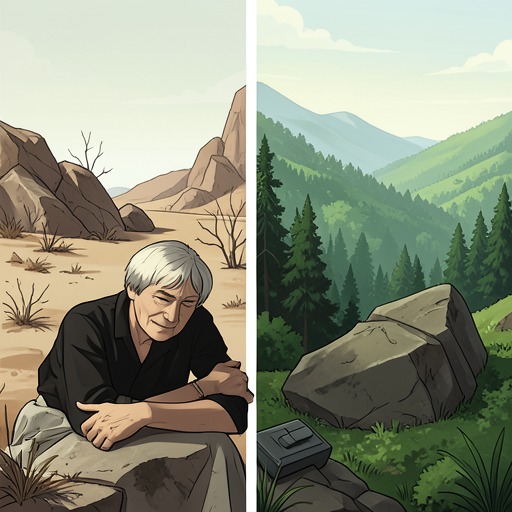
The Dust, a vast inland region stretching across the plains of Southwest, is the most visible record of Anarres’s ecological transformation. In an earlier geological era it had been an immense forest of holums, the planet’s dominant plant genus. A hotter, drier climate and millennia of drought killed the trees and reduced the soil to fine grey dust, which wind raised into barren hills. In Shevek’s time, the long beaches of Southeast could support fishing and farming communities, but arable land there remained a narrow strip along the sea; the interior and westward plains were largely uninhabited apart from isolated mining towns. Scarcity is therefore unevenly distributed across the planet: habitable and productive areas exist, but they occupy only a limited part of a much larger, inhospitable landscape.
The effort to replant the West Temaenian Littoral gives this damaged environment a history and a possible future. The project employed nearly eighteen thousand people for two years during the fifteenth decad of the Settlement of Anarres. Its scale reflects a collective attempt to restore land rather than simply extract from it. Shevek sees the reforestation as resonant with Causative Reversibility, an idea neglected by the respectable Sequency school but still present in Odonian thought: the effort to repair a consequence by acting upon its causes. At eighteen, he hopes to connect Odo’s thinking about ends and means with temporal physics, although he recognizes that he must return to physics before he can write the paper he imagines. The ecological undertaking thus links practical restoration to an intellectual question about whether damaged conditions can be changed through deliberate action.
A Narrow and Interdependent Ecology
Anarres’s land and seas sustain markedly different forms of life. Its three oceans, isolated from one another for millions of years, contain diverse animal communities whose separate evolutionary histories have produced a bewildering range of forms. On land, by contrast, plants survive in sparse, spiny forms, while most animals adapted to breathing air have disappeared during the planet’s long period of dust and dryness. Bacteria, including lithophagous forms, and a few hundred species of worms and crustaceans persist, but the terrestrial food web is exceptionally limited.
Human settlement fits into this narrow ecology only under restrictive conditions. Fishing can be sustained if it is not too intensive, and cultivation can work when organic wastes are used as fertilizer. There is no grass to support herbivores, no herbivore population to support carnivores, and few insects to pollinate flowering plants; imported fruit trees therefore require hand-fertilization. The Settlers did not introduce animals from Urras, which could have disrupted the fragile balance, and arrived with as little of their personal flora and fauna as possible. Even fleas did not establish themselves on Anarres. The account makes the settlers’ ecological isolation concrete: the planet is not an empty version of a more abundant world but a habitat whose limited relationships can be disturbed by additions as well as sustained by restraint.
Takver, a fish geneticist, helps Shevek perceive this difference through the laboratory aquaria. She studies methods of increasing and improving edible fish stocks, work that combines factual research with a practical aim. Shevek is fascinated by the tanks, where the abundance and complexity of marine life contrast with the sparse animal life on land. Takver describes the sea as a web of organisms feeding upon one another and contrasts it with the few terrestrial animal groups on Anarres. Her comparison makes the planet’s isolation a biological condition, not just a political one: on Urras, she observes, land animals and insects are far more numerous and varied, and people would encounter other creatures throughout their surroundings. Shevek’s attention to the fish leads him beyond a physicist’s habitual focus on explanation, toward beings that exist without having to justify their ways to humans.
Scarcity, Labor, and Dependence
Ecological limits shape daily work and the organization of unpleasant or dangerous tasks. The community distributes disagreeable jobs through rotating lists: people can be asked to take such work for a day in each decad, while especially hazardous postings, including mercury mining, normally last only half a year. This system is acknowledged to be inefficient because workers may still be learning a job, but the alternative would be to leave people in work that could cripple or kill them over time. The rule expresses a social response to material necessity: dangerous work still has to be done, but its burdens are not supposed to become a permanent condition imposed on a fixed class of workers.
Anarres’s scarcity also gives its trade with Urras an uneasy economic and political importance. Freighters arrive only eight times a year, bringing fossil oils and petroleum products, delicate machine parts, electronic components, and sometimes new strains of fruit trees or grain for testing. They leave with mercury, copper, aluminum, uranium, tin, and gold. Anarresti critics protest the arrangement as profitable trade with propertarian warmakers, while its defenders argue that the cost of mining the ores themselves helps deter an invasion. The bargain is therefore both a material exchange and a security calculation. Although the settlement calls itself a free world, it functions as a mining colony in relation to Urras; seven generations of peace have not erased the humiliation or produced trust. Ecological scarcity does not simply make the planet self-reliant: it coexists with dependence on imported supplies and with the export of mineral wealth.
Drought and the Limits of Solidarity
The Great Drought turns chronic ecological vulnerability into an immediate crisis. In one winter, cold and dry conditions leave Abbenay’s streets swept by frozen dust. Water for baths is strictly rationed because thirst and hunger take priority over cleanliness. Food and clothing for Anarres’s twenty million inhabitants depend on holum plants, from leaf, seed, fiber, and root, while warehouses contain some textile stock but little reserve food. Water is directed to the land to keep those plants alive. The city’s needs are therefore joined to the survival of its crops: saving water for human comfort competes with preserving the food and materials on which the population depends.
The pressure extends beyond the farms to the transport system. After a year of drought, ordinary transport lines cannot meet the emergency, even with strenuous efforts from the transport workers. The transport federative, normally flexible and effective, presses every available truck, train, ship, port, and dirigible into service and relies on apprentices, retired workers, volunteers, and emergency draftees. Yet vehicles and operators are still insufficient. A provision train takes priority over Shevek’s train, which then stops for twenty hours after a dispatcher’s error and a wreck farther along the line. The interruption shows how ecological crisis can travel through infrastructure: scarce food must move between regions, but the network carrying it is itself under strain.
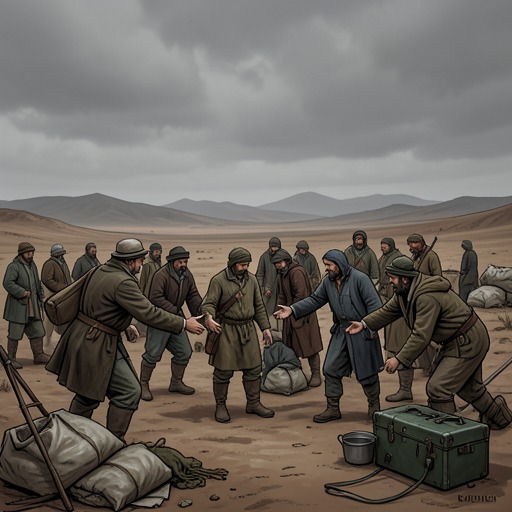
At the mill town where the train stops, the conflict between need and limited supply becomes immediate. The town has no spare food in its commons or warehouses and depends on transport for its own provisions. Its 160 residents face 450 hungry passengers. Sharing what little the town has might leave the residents without food for days, with no certainty about when the next provisions train will come; the townspeople give the passengers nothing. The travelers fast for sixty hours before reaching a station with a stocked refectory. For Shevek, who has never before experienced hunger, the delay alters an abstract concern into a question about what happens when there is not enough to share. He considers how scarcity can invite force, power, and violence, and how people may protect themselves by refusing to look at those in need. The passengers discuss raiding the town’s truck gardens, but the train departs before that proposal is carried out. Their eventual meal—bread and soup—restores their spirits, and they return to the train laughing together, having endured the wait as a group.
The famine also turns distribution into a question of authority and personal responsibility. A former worklister recalls that, during the drought, the mill syndicate cut rations according to work capacity: full-time workers received barely enough for their labor, people on half time received three-quarter rations, and people too sick or weak to work received half. Those reduced rations could keep a person alive without allowing recovery and a return to work. As a worklister, the speaker had to put already sick people on half rations, while receiving full rations for the desk work of making those lists. He quit and went to Grand Valley, but another person took over the task at the mills. The replacement does not resolve the moral problem: an institutional list can shift responsibility from one worker to another without making the decision less consequential.
Shevek’s argument with Bedap sets this material danger beside the purpose of Odonian solidarity. Shevek insists that the failure obstructing individual creativity is not simply the society’s organization but Anarres’s poverty: on a barren planet, people must give up some personal desires for the common good because solidarity is their only resource. Bedap agrees that solidarity is essential, but argues that cooperation has hardened into obedience and that social conscience has become a bureaucratic power. Their disagreement turns ecological constraint into a political problem. Scarcity explains why collective discipline may be necessary, but it does not settle who controls that discipline, how decisions are made, or whether the vulnerable are treated as members of the community.
Ecological Limits and Political Meaning
The novel does not treat Anarres’s poverty as a simple proof that scarcity inevitably produces either virtue or domination. The drought exposes the difference between sharing when barely enough remains and deciding what to do when supply fails altogether. In the stranded train, the town’s refusal, the passengers’ anger, and the unrealized possibility of raiding the gardens show mutual aid under pressure without reducing either side to an easy moral emblem. The later account of ration lists makes the same crisis institutional: unequal capacities to work become rules about who receives food, and the person assigned to administer those rules experiences the decision as an unbearable power over other lives.
At the same time, the material setting gives Shevek’s appeal to solidarity its force. The planet’s limited ecology requires restraint in fishing, care in cultivation, and work to restore damaged land; its population also relies on transport links and imports that complicate any ideal of self-sufficiency. Ecological scarcity is consequently both a physical limit and a recurring test of social arrangements. It explains the demands placed on Anarresti cooperation, while the novel’s famine episodes ask whether cooperation remains voluntary and humane when people face hunger, administrative decisions, and inadequate supplies. The land cannot be made abundant by good intentions, but the way scarcity is shared—and the way its costs are assigned—remains a social choice.